

Daniel Stein Kokin, the Bildner Center’s Norman and Syril Reitman Visiting Professor, will introduce his innovative digital mapping project, “All the Points,” which examines the creation of Zionist and Israeli communities in the Land and State of Israel from the 19th century to the present. The mini-course takes as its starting point the classical Zionist notion of each new community as “‘od nekudah ‘al ha-mappah” (“another point on the map”).
“All the Points” is an important new research tool that traces the presence, founding, disappearance, and evolution of Jewish, Arab, European Christian, and other communities in the region on an annual basis from 1840 to 2023. The dynamism of digital mapping captures the area’s profound religious, ethnic, and ideological diversity as well as its tremendous demographic changes in a way that traditional mapping is unable to do.
PDF For Program (This archived document is no longer maintained and may not meet accessibility standards. To request content in an accessible format, contact us.)
Mini-Course Session Details:
Week 1 (December 3): Getting to the Point
The first session will showcase the role of this rhetoric of points throughout the history of Zionism and Israel, highlighting:
1) the prominence of this concept in the formative period of Zionism, as exemplified by aḥat-esreh ha-nekudot (the eleven points), the settlements established in the Negev desert during the night of October 5–6, 1946;
2) its intensification in the post-1967 and, especially, post-1973 settler movement, as reflected in the pro-settlement publication Nekudah. (Point.); and
3) the subsequent critique of this rhetoric as valuing the map over its constituent communities, as demonstrated in the Israeli rock band Teapacks’ 1995 satirical song Ma‘aleh ’Avak (Raising Dust) about a fictional, forlorn city on Israel’s periphery.
Week 2 (December 10): Some of “All the Points”
The second session will introduce the “All the Points” digital mapping project and explore how settlement changes on the ground have influenced peace plans across the decades (e.g., the Peel Commission Plan, United Nations Partition Plan, Clinton Parameters, and Trump Vision for Peace).
Week 3 (December 17): Points of the Imagination
The third session will explore Israeli and Palestinian communities imagined in literature and the arts, as documented in a curated map, “Points that Never Were.” Examples include Neudorf (New Village), the idealized farming village described by the Zionist thinker Theodor Herzl in his novel Altneuland; Kibbutz Metzudat Ram (High Fortress), from the Israeli writer Amos Oz’s Elsewhere, Perhaps; and Beit ha-Tikvah (House of Hope), from the Israeli film and hit Broadway musical The Band’s Visit.
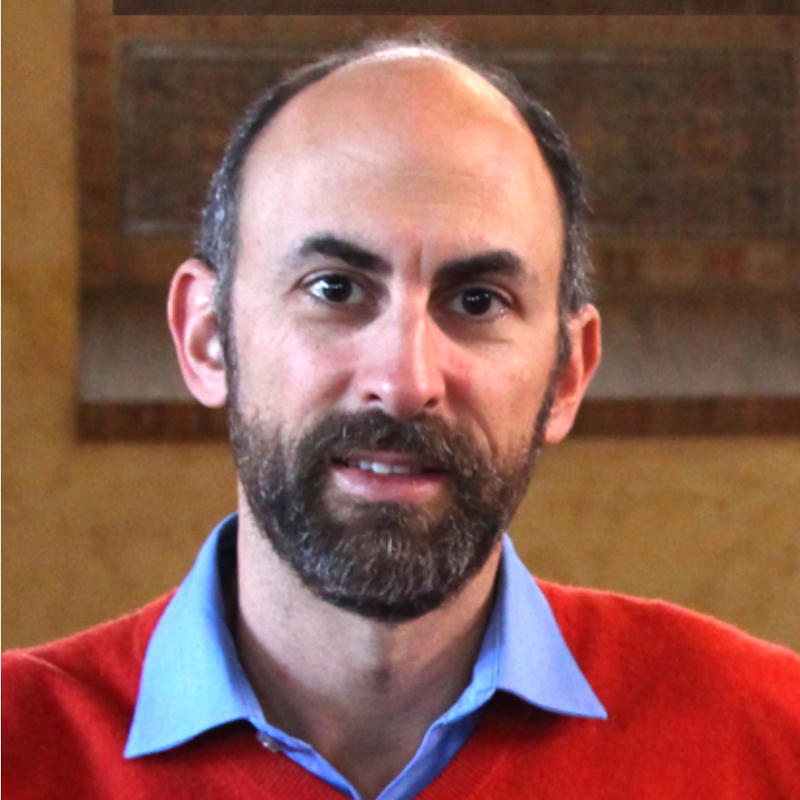 Dr. Daniel Stein Kokin is a scholar of Jewish studies affiliated with Arizona State University and the upper school librarian of the Ramaz School in New York City. He has previously taught at Yale, UCLA, the University of Oregon, and the University of Greifswald (Germany) and has held fellowships at Villa I Tatti: The Harvard University Center for Italian Renaissance Studies in Florence, Italy, the Käte Hamburger Kolleg in Bochum, Germany, and the Schusterman Center for Israel Studies at Brandeis University. He has researched and published widely on topics in rabbinic literature, Jewish history, Jewish-Christian relations, and Israeli music, film, and art. He is also the founder and director of the “All the Points” project, which produces interactive, online maps tracing the history of settlement in the Land of Israel, past and present.